Table of Contents
Cloud Computing Essentials Unlock Benefits: Everything You Need to Know
Cloud computing has transformed how people and businesses store data, run applications, and deliver digital services. Whether you’re streaming videos, collaborating on documents online, or managing a global business, chances are you’re already using cloud technology without even realizing it.
Over the past decade, cloud adoption has accelerated as organizations look for flexible, scalable, and cost-effective ways to operate. Instead of investing heavily in physical servers and expensive IT infrastructure, businesses can access computing resources whenever they need them and pay only for what they use.
Understanding how Cloud Computing Essentials Unlock Benefits isn’t just important for IT professionals. Business owners, entrepreneurs, students, and everyday users can all benefit from knowing how cloud services work and why they have become the backbone of modern technology.
This guide explains cloud computing in simple language, explores its deployment and service models, highlights its biggest advantages, and shares practical tips to help organizations make informed cloud decisions.
What Is Cloud Computing?
Cloud computing is the delivery of computing services—including servers, storage, databases, networking, software, analytics, and artificial intelligence—over the internet instead of relying solely on local computers or on-premises data centers.
Rather than purchasing expensive hardware and maintaining it in-house, users can rent computing resources from cloud providers whenever they need them. This approach reduces upfront investment while improving flexibility and efficiency.
For example:
- Saving photos to Google Photos
- Using Microsoft 365 online
- Streaming content on Netflix
- Backing up files with Dropbox
- Running business applications on Amazon Web Services (AWS)
All of these services rely on cloud computing in one way or another.
As technology continues to evolve, understanding Cloud Computing Essentials Unlock Benefits that help businesses remain competitive, reduce operational costs, and improve customer experiences.
Why Cloud Computing Matters Today
Digital transformation has become a priority across nearly every industry. Companies need systems that can scale quickly, support remote work, protect sensitive information, and adapt to changing customer demands.
Cloud computing provides these capabilities without requiring businesses to build and maintain massive data centers.
Today, organizations use cloud technology to:
- Host websites and applications
- Store and analyze data
- Support remote employees
- Develop software faster
- Improve disaster recovery
- Enhance cybersecurity
- Deliver digital services worldwide
For individuals, cloud computing makes daily life easier by allowing seamless access to files, emails, and applications from virtually any internet-connected device.
This widespread adoption demonstrates how Cloud Computing Essentials Unlock Benefits for organizations of every size, from startups to multinational enterprises.
Understanding Cloud Computing Essentials
Before moving workloads to the cloud, it’s important to understand the core principles that influence performance, cost, security, and scalability.
These cloud computing essentials serve as the foundation for every successful cloud strategy.
1. Scalability
Scalability refers to the ability to increase or decrease computing resources based on demand.
For example, an online retailer may experience a massive increase in website traffic during holiday sales. Instead of purchasing additional servers that remain unused for most of the year, cloud platforms automatically allocate more resources during peak periods and reduce them afterward.
This flexibility allows businesses to handle traffic spikes efficiently while avoiding unnecessary expenses.
Understanding scalability is one of the key ways Cloud Computing Essentials Unlock Benefits that traditional IT infrastructure often cannot match.
2. Elasticity
Elasticity is closely related to scalability but focuses on automatic resource adjustment in real time.
If user demand suddenly doubles, cloud infrastructure can respond immediately by increasing computing capacity. Once traffic decreases, those extra resources are released automatically.
This ensures optimal performance while controlling costs.
3. Pay-as-You-Go Pricing
Traditional IT environments require large capital investments in hardware, maintenance, cooling systems, and software licenses.
Cloud providers offer a usage-based pricing model where organizations only pay for the resources they actually consume.
Benefits include:
- Lower upfront costs
- Better budget planning
- Reduced hardware waste
- Improved cash flow
- Easier business expansion
Many companies discover that Cloud Computing Essentials Unlock Benefits by turning fixed infrastructure expenses into predictable operational costs.
4. High Availability
Downtime can lead to lost revenue, reduced productivity, and damaged customer trust.
Cloud providers design their infrastructure with redundancy across multiple data centers to minimize service interruptions.
Features commonly include:
- Automatic failover
- Multiple availability zones
- Load balancing
- Continuous monitoring
- Built-in backup systems
This allows applications to remain available even if individual servers experience failures.
5. Reliability
Reliability ensures that cloud services continue operating consistently over time.
Leading cloud providers invest billions in infrastructure, networking, monitoring, and security to maintain high service availability.
Organizations benefit from:
- Stable performance
- Continuous updates
- Hardware redundancy
- Automated maintenance
- Faster incident recovery
6. Security
Security remains one of the most discussed aspects of cloud computing.
Modern cloud platforms provide advanced security capabilities such as:
- Data encryption
- Identity and Access Management (IAM)
- Multi-factor authentication
- Continuous monitoring
- Threat detection
- Security logging
- Compliance certifications
However, cloud security follows a shared responsibility model.
The provider secures the infrastructure, while customers remain responsible for:
- User permissions
- Password policies
- Data classification
- Application security
- Network configuration
Organizations that understand this model gain another reason why Cloud Computing Essentials Unlock Benefits beyond simple cost savings.
Types of Cloud Deployment Models
Choosing the right deployment model is one of the most important decisions in any cloud strategy.
Different organizations have different security, compliance, performance, and budget requirements.
Public Cloud
Public cloud services are provided over the internet by companies such as:
- Amazon Web Services (AWS)
- Microsoft Azure
- Google Cloud Platform (GCP)
Resources are shared among multiple customers while remaining logically isolated.
Advantages
- Low initial investment
- Rapid deployment
- Global availability
- Automatic updates
- Virtually unlimited scalability
Best For
- Startups
- Small businesses
- Mobile applications
- Web hosting
- Software development
- Testing environments
Private Cloud
A private cloud provides dedicated computing resources for a single organization.
Infrastructure may be hosted internally or managed by a third-party provider.
Private clouds are commonly used where organizations must meet strict compliance or regulatory requirements.
Advantages
- Greater control
- Enhanced customization
- Higher security
- Better compliance management
- Dedicated infrastructure
Best For
- Government agencies
- Healthcare organizations
- Financial institutions
- Large enterprises
Hybrid Cloud
Hybrid cloud combines public and private cloud environments.
Organizations can keep sensitive workloads in private infrastructure while using public cloud resources for less critical applications.
For example:
Customer records remain in a private environment while the company’s website, analytics platform, and collaboration tools operate in the public cloud.
This approach balances security, flexibility, and cost efficiency.
Many organizations find that Cloud Computing Essentials Unlock Benefits most effectively through a well-planned hybrid cloud strategy that aligns with business goals.
Multi-Cloud
A multi-cloud strategy involves using services from more than one cloud provider.
For example:
- AWS for application hosting
- Azure for Microsoft-based workloads
- Google Cloud for data analytics
Although this approach offers flexibility, it also increases operational complexity and requires skilled management.
Organizations should adopt multi-cloud only when there is a clear business or technical need.
Also Read: XRP Price Forecast
Cloud Service Models Explained
Beyond deployment models, cloud computing also offers different service models based on how much responsibility the provider manages.
Infrastructure as a Service (IaaS)
IaaS provides virtual machines, storage, networking, and other infrastructure components.
Businesses manage:
- Operating systems
- Applications
- Security configurations
- Middleware
The cloud provider manages:
- Physical servers
- Storage hardware
- Networking infrastructure
- Virtualization
IaaS is ideal for organizations needing maximum flexibility while avoiding hardware investments.
Platform as a Service (PaaS)
PaaS provides a managed development environment where developers can build, test, and deploy applications without managing servers or operating systems.
This model accelerates software development while reducing infrastructure maintenance.
It is particularly useful for development teams focused on innovation rather than server administration.
Software as a Service (SaaS)
Software as a Service (SaaS) is the most widely used cloud service model. Instead of installing software on individual computers, users access applications through a web browser. The cloud provider handles everything from infrastructure and updates to maintenance and security patches, allowing users to focus on their work.
Popular SaaS applications include:
- Microsoft 365
- Google Workspace
- Zoom
- Salesforce
- Dropbox
- Slack
Benefits of SaaS
- No software installation required
- Automatic updates
- Lower maintenance costs
- Easy collaboration
- Access from anywhere
- Subscription-based pricing
For businesses looking to improve productivity while reducing IT overhead, SaaS demonstrates how Cloud Computing Essentials Unlock Benefits through simplicity and convenience.
How Cloud Computing Essentials Unlock Benefits for Businesses
Organizations across industries are adopting cloud technology because it delivers measurable business value. From startups to multinational corporations, cloud computing supports growth, innovation, and operational efficiency.
1. Reduced IT Costs
One of the biggest advantages of cloud computing is cost savings. Traditional IT infrastructure requires purchasing servers, networking equipment, storage devices, and backup systems. Businesses must also budget for electricity, cooling, maintenance, and hardware replacement.
Cloud services replace these large upfront investments with flexible monthly or usage-based pricing.
This allows companies to:
- Reduce capital expenditure
- Lower maintenance costs
- Pay only for what they use
- Scale resources without purchasing new hardware
These financial advantages clearly show how Cloud Computing Essentials Unlock Benefits for businesses aiming to optimize their budgets.
2. Greater Scalability
Business demands constantly change. Seasonal sales, marketing campaigns, or product launches can dramatically increase website traffic.
Cloud platforms allow organizations to scale resources up or down within minutes instead of waiting weeks or months for new hardware.
Benefits include:
- Better customer experience
- Faster response to demand
- Reduced downtime
- Improved operational efficiency
3. Improved Business Continuity
Unexpected events such as hardware failures, cyberattacks, or natural disasters can disrupt business operations.
Cloud providers offer built-in redundancy, backup solutions, and disaster recovery services that help organizations recover quickly.
A strong disaster recovery strategy minimizes:
- Revenue loss
- Customer dissatisfaction
- Operational downtime
- Data loss
4. Enhanced Collaboration
Modern workplaces rely heavily on remote and hybrid work models.
Cloud computing allows employees to securely access files, applications, and collaboration tools from virtually anywhere.
Teams can:
- Edit documents simultaneously
- Share information instantly
- Conduct virtual meetings
- Manage projects collaboratively
This flexibility increases productivity while supporting distributed workforces.
5. Faster Innovation
Launching new applications traditionally required purchasing servers and configuring infrastructure.
Cloud platforms simplify this process by providing ready-to-use development environments, managed databases, AI tools, and analytics services.
Businesses can:
- Build applications faster
- Test ideas quickly
- Launch products sooner
- Experiment with new technologies
Innovation becomes more accessible when Cloud Computing Essentials Unlock Benefits that reduce technical barriers.
Common Cloud Computing Use Cases
Cloud technology powers countless digital services across industries.
Some of the most common use cases include:
Website Hosting
Businesses host websites on cloud platforms to improve speed, reliability, and scalability.
Data Storage and Backup
Cloud storage enables secure file sharing, automatic backups, and easy access from multiple devices.
Software Development
Developers use cloud platforms to build, test, and deploy applications more efficiently.
Artificial Intelligence and Machine Learning
Cloud providers offer managed AI services that eliminate the need for expensive computing infrastructure.
Big Data Analytics
Organizations process massive datasets using cloud-based analytics tools to improve business decisions.
Internet of Things (IoT)
Connected devices generate enormous amounts of data, which cloud platforms collect, process, and analyze in real time.
Choosing the Right Cloud Provider
Selecting the right provider is about more than comparing features. Businesses should evaluate their current needs, future growth plans, and compliance requirements.
Amazon Web Services (AWS)
AWS is known for its extensive range of services, global infrastructure, and mature ecosystem. It is widely used by startups, enterprises, and government organizations.
Microsoft Azure
Azure integrates well with Microsoft products, making it a popular choice for businesses already using Windows Server, Microsoft 365, and Active Directory.
Google Cloud Platform (GCP)
Google Cloud excels in data analytics, machine learning, and container technologies, making it attractive for organizations focused on modern application development.
Factors to Consider
When selecting a cloud provider, evaluate:
- Pricing structure
- Global data center availability
- Security certifications
- Compliance requirements
- Customer support
- Managed services
- Performance
- Integration capabilities
- Scalability
- Backup and disaster recovery options
Rather than chasing every feature, focus on the provider that best aligns with your business goals. This practical approach reinforces how Cloud Computing Essentials Unlock Benefits through informed decision-making.
Best Practices for Cloud Adoption
Migrating to the cloud requires careful planning to maximize value.
Assess Existing Infrastructure
Review your current applications, databases, and workloads to determine which systems are suitable for migration.
Create a Migration Strategy
Organizations commonly choose one of these approaches:
- Rehost (Lift and Shift)
- Refactor
- Replatform
- Repurchase
- Retire outdated applications
- Retain systems that should remain on-premises
Implement Strong Security
Security should be integrated into every stage of cloud adoption.
Recommended practices include:
- Multi-factor authentication
- Encryption at rest and in transit
- Regular security audits
- Identity and Access Management (IAM)
- Continuous monitoring
- Backup verification
Monitor Cloud Costs
Without proper oversight, cloud expenses can increase over time.
Use cost management tools to:
- Track spending
- Set budget alerts
- Identify unused resources
- Optimize storage
- Right-size virtual machines
Train Employees
Technology alone doesn’t guarantee success. Ensure employees understand cloud tools, security policies, and operational best practices.
Common Mistakes to Avoid
Many cloud projects encounter avoidable challenges.
Ignoring Cost Optimization
Unused storage, oversized virtual machines, and idle resources can significantly increase monthly bills.
Weak Access Controls
Grant employees only the permissions they need to perform their roles.
Skipping Backup Plans
Even with cloud infrastructure, businesses should maintain reliable backup and disaster recovery strategies.
Poor Migration Planning
Moving applications without evaluating dependencies can lead to performance issues and unexpected downtime.
Overlooking Compliance
Industries such as healthcare and finance must meet strict regulatory requirements regarding data protection and privacy.
Avoiding these mistakes helps organizations fully realize how Cloud Computing Essentials Unlock Benefits in a secure and sustainable way.
Future Trends in Cloud Computing
Cloud technology continues to evolve rapidly.
Key trends shaping the future include:
Artificial Intelligence Integration
Cloud providers are embedding AI capabilities into their platforms, making intelligent automation more accessible.
Edge Computing
Processing data closer to users reduces latency and improves performance for real-time applications.
Serverless Computing
Developers can focus on writing code while cloud providers automatically manage infrastructure.
Green Cloud Computing
Providers are investing in renewable energy and energy-efficient data centers to reduce environmental impact.
Industry-Specific Cloud Solutions
Healthcare, finance, education, and manufacturing are increasingly adopting cloud platforms tailored to their unique compliance and operational needs.
As these innovations mature, Cloud Computing Essentials Unlock Benefits that extend beyond infrastructure, enabling smarter operations and new business opportunities.
Conclusion
Cloud computing has become a fundamental part of modern digital transformation. Whether you’re a small business looking to reduce IT costs or a large enterprise seeking greater scalability, understanding the core principles of cloud technology is essential.
From choosing the right deployment model to implementing strong security practices and managing costs effectively, every decision influences long-term success.
Rather than viewing cloud adoption as simply moving data to the internet, organizations should treat it as an opportunity to improve efficiency, strengthen resilience, and accelerate innovation.
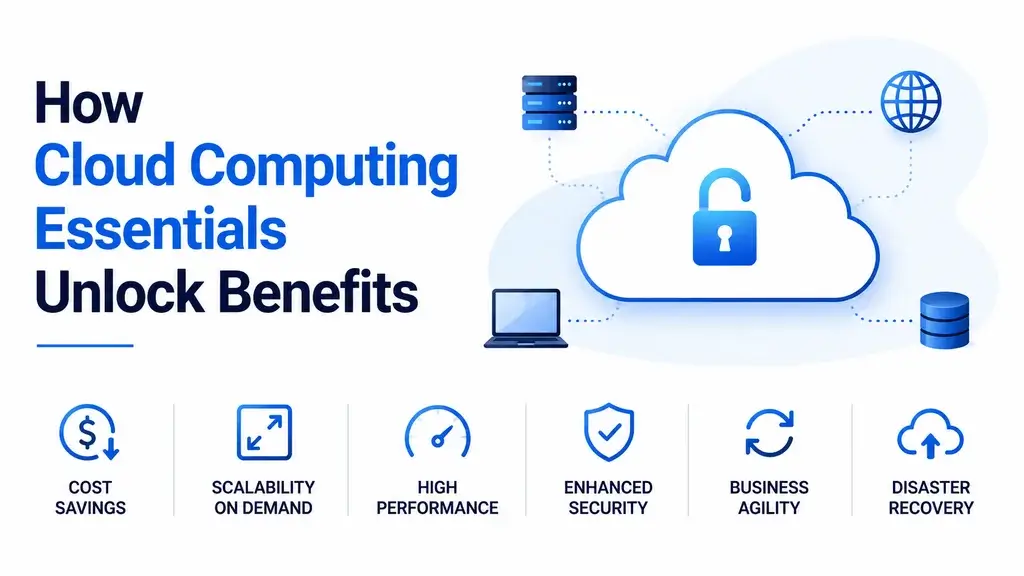
When approached strategically, Cloud Computing Essentials Unlock Benefits that include lower operational costs, better collaboration, enhanced security, faster scalability, and greater business agility. By selecting the right cloud services, following best practices, and continuously optimizing resources, businesses can maximize the value of their cloud investments for years to come.
Frequently Asked Questions (FAQs)
1. What are cloud computing essentials?
Cloud computing essentials include scalability, elasticity, security, reliability, deployment models, service models, and cost optimization strategies. Understanding these concepts helps organizations make better technology decisions.
2. How do Cloud Computing Essentials Unlock Benefits for businesses?
They help businesses reduce infrastructure costs, improve scalability, enhance security, increase operational efficiency, and support innovation through flexible cloud services.
3. Which cloud deployment model is best?
It depends on business needs. Public cloud suits most organizations, private cloud is ideal for strict compliance requirements, while hybrid cloud offers a balance between flexibility and security.
4. Is cloud computing secure?
Yes. Leading cloud providers invest heavily in security. However, businesses must also protect user accounts, configure permissions correctly, encrypt sensitive data, and monitor cloud environments regularly.
5. What is the difference between IaaS, PaaS, and SaaS?
- IaaS: Provides virtual infrastructure such as servers and storage.
- PaaS: Offers a platform for building and deploying applications.
- SaaS: Delivers fully managed software over the internet.
6. Can small businesses benefit from cloud computing?
Absolutely. Cloud services help small businesses reduce upfront costs, improve collaboration, access enterprise-grade technology, and scale as they grow.
7. How can businesses reduce cloud costs?
Businesses should monitor usage, remove unused resources, right-size virtual machines, automate scaling, implement budget alerts, and regularly review cloud spending reports.
8. What industries use cloud computing?
Almost every industry uses cloud computing, including healthcare, finance, education, retail, manufacturing, entertainment, government, and technology.