
At the beginning of my career, I mistakenly believed that AI would take over highly technical and administrative tasks, lessening the overall workload.
But learning practical AI skills to support HR functions simply isn’t enough to lead employees.
This is because modern team management not only requires collaboration with AI to improve human productivity. It also requires promoting empathy to bring positive change.
As I progressed in my career, I came to understand the importance of the CIPD qualification, which transformed me into who I am today.
Courses such as evidence-based HR, organizational design, and data analytics allowed me to sync workforce capabilities with primary business objectives.
Now, as a senior HR executive, I highly regard CIPD qualification as it transforms managers into strategic business leaders.
In this blog, I’ll walk you through the key takeaways on how CIPD qualification improves leadership roles that boost profit.
Table of Contents
Implement People Strategy for Business Growth
To apply an effective people strategy for sustainable business growth, it is crucial to align your employee goals with primary financial objectives.
Move From Traditional HR to Strategic HRM
The important question is what differentiates traditional HR roles from strategic HR management. While traditional HRM is seen as a cost center, strategic HRM positions HR as a value driver. Both approaches are equally necessary.
Traditional HR management is built around administration, day-to-day tasks, and employee relations. Its focus is activity-based and on maintaining productivity.
In contrast, the main focus of strategic HR management is creating outcome-based business strategies that require proper planning (1 to 5 years). Strategic HRM serves businesses as a partner to offer data-driven decisions. The aim is to minimize administrative effort so the team can prioritize tasks that provide a competitive edge.
When I was in CIPD Level 3, I discovered how businesses can align well-being metrics with performance data to achieve lower turnover rates, lower healthcare costs, and increased revenue.
Here are the basic methods I used HR metrics to track staff well-being:
- I estimated the costs of sick days, short-term health disabilities, and increasing health insurance costs.
- I measured the turnover costs of employee attrition.
- I calculated presenteeism using pulse surveys to understand reduced productivity when individuals come to work but underperform due to stress.
- I also used employee net promoter score (eNPS) to track how often employees recommend my company to others. Then measured high scores against higher sales or task completion rates.
You’ve collected all the data. But how to analyze it? It’s very simple.
- All you need to do is compare the financial performance, turnover rates, and medical leave usage of employees with high engagement scores against those with comparatively lower scores.
- You may also use statistical tools to correlate that a certain percentage increase in well-being leads to a definite rise in quarterly revenue.
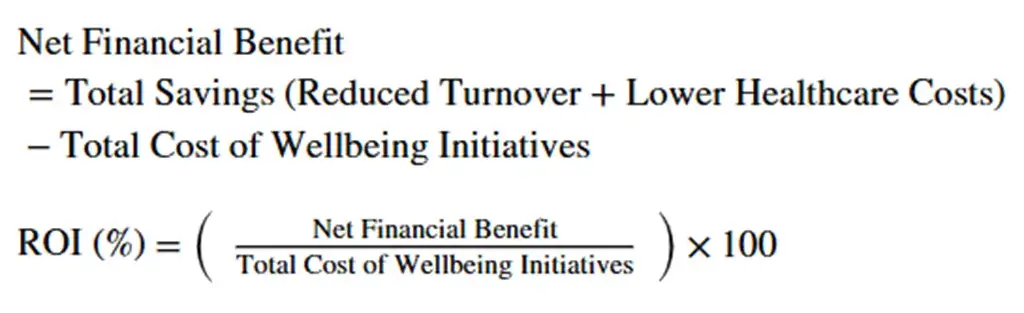
- Lastly, use this simple financial formula to calculate your Return on Investment (ROI):
Design Better Work Environment:
Generally, I’ve observed that in both personal and professional life, transparent communication is the foundation for strengthening interpersonal relationships.
Likewise, building trust in the workplace is essential for a positive work culture. This also strengthens bonds among employees.
Here are my key strategies to practice in your daily operations:
- You should have an open dialogue with employees to address concerns, share creative ideas, and voice constructive feedback. This not only creates an atmosphere where individuals feel heard but also allows teams to participate with leaders.
- You must establish clear grounds of expectations for different roles and responsibilities. This minimizes internal confusion among employees and boosts accountability. Team members are more likely to put trust in business leaders and their decisions.
- Trust building doesn’t happen in weeks. It demands time and consistency. Leaders are judged on how well their actions get aligned with their words. This assures employees that leadership will act in their best interests.
- Practicing modeling behavior drastically improves trust levels within team members. The business leaders who are more vulnerable and openly discuss their professional experiences build a safe space and invite others to do the same.
As company leaders prioritize trust-building, they strengthen the foundation for stronger partnerships, increased performance, and better morale.
Besides, the CIPD qualification focuses on creating inclusive and fair HR policies in workplaces where employees feel encouraged, valued, and honored to be a part of that organization.
Let me share a secret!
To be honest, I felt difficulty while managing my HR internships with an overwhelming CIPD coursework schedule. My only option was to get professional CIPD assignment help. The qualified HR tutors significantly improved my analytical research skills and assignment format, and I didn’t have to spend hours proofreading every document.
Now back to our main storyline.
The vision is not only to comply with company standards but also to foster a positive work culture.
Here I’m listing the 8 HR policies every organisation must have:
- Promote fair treatment by creating equal opportunities for everyone irrespective of their race, religion, age, gender, disability, sexual orientation, and pregnancy status.
- Employers are obligated to promote the health, safety, and welfare of their employees. A health and safety policy is a legal requirement for every company that meets safety rules, identifies hazards, and explains the regulations employees must follow.
- Outline clear disciplinary and grievance procedures to handle misconduct or disciplinary issues and employee complaints for fair dealing and compliance with employment rules. By following these processes, a business remains safeguarded from employment tribunals.
- Addressing a clear absence management policy is vital for how sick days are reported, what evidence is required, and how the workplace handles employee absence. This helps reduce unauthorised leave and supports genuine sick leave.
- HR managers must explain time off, notice periods, and the total number of holiday leaves in a detailed annual leave policy. It should openly state whether the leaves cover salaries, what happens to unused leaves and restrictions for taking leave during busy seasons.
- With rising data security concerns, companies must provide clear instructions regarding data protection and confidentiality on handling sensitive data, personal information, and security systems. It should also mention the consequences for security breaches.
- Since the COVID-19 lockdown, working arrangements have changed globally, including on-site, remote and hybrid modes of work. A flexible working policy states the conditions for working remotely, request procedure, and eligibility criteria for employees.
- A social media and AI use policy is crucial for clear boundaries on how individuals represent the business online and how advanced AI tools should be used.
If you need expert guidance on how to identify which policy would work best in your company’s interest, then getting professional 5 and CIPD level 7 assignment help would be great for you. You will learn how to write in a correct formal tone, understand the statement of purpose, and whether the policy fits the CIPD standards.
My Final Verdict on CIPD Training!
Frankly, when I look back on my professional HR leadership journey, I can firmly say that the CIPD qualification has been one of the most treasured investments in my HR career. It taught me that HR responsibilities are far beyond the traditional HR administrative operations.
Now I’m able to confidently practice strategic decisions, strong analytical skills, and employee-centered practices to grow business with empathy and trust.
From my experience, CIPD is more than just a qualification. A road to becoming an influential business leader.